Bhati
| Bhati | |
|---|---|
| Flag | |
 | |
| Government | |
| Government | Monarchy or Cheifdoms |
• The Great Head of the 9 Houses | Chakri AXSLD Dheraj |
| Culture | |
| Language | Bhati |
| Religion | Bhati |
| Motto | "Vhaij, Ghama, Mand" |
| Links | |
| Discord | Bhati discord |
THIS IS HISTORY AND CULTURE SEEN THROUGH THE EYES OF THE BHATI PEOPLE
History
Beginning of the world
There was nothing but an endless void called Thatagevati, a god with 3 eyes, one nose, and one mouth, for millions of years he floated in nothingness. Over time, he grew tired and lonely. Suddenly, one day, Bhat formed from the nose of his son, Thatagevati. Bhat's radiance warming up his son, his breath filling his son with simple life forms. This worked for 100s of years till Bhat grew tired of not being worshipped to fix this. Bhat spat into the mouth and 2 main eyes of Thatagevati, forming a Humanoid life, the Vha. Each of Thatagevati's parts is a dimension: his left eye is Vhalti, his right Vhabha, his mouth Vhalme, and his third eye Vhalgat.
Chigravati Saga
100s of years passed by once more as Bhat watched his creations form communities that gathered fruit, hunted, and made small settlements. Bhat once again grew bored, so he sliced open his chest, pulling out his left rib. Clenching it with his fist, he infused his life force, creating Chigravati. She instantly took the form of an elderly Vha lady and taught the different communities to trade, to speak one language, to use portals, and make sure they worshipped Bhat before ascending to the sky to guide lost new friends with the stars and with dreams. Bhat took notice of Vhabha and Vhalme as they worshiped Chigravati, and in a jealous rage, Bhat threw him self into the sky and murdered Chigravati, splitting up her body into 24 sections so no one could ever worship the full body of Chigravati.
The Dhai Wars


The death and reincarnation of Chigravati wasn't enough for Bhat, so he took the form of the Queen of Vhalti and begged the king to invade the other dimensions for still being pagans. BheBhe, the king, after hearing his "wife's" dismay, declared the first ever war the universe ever saw. Quickly forming over 200 Battalions from Vhas all around the world, he flooded portals having multiple fronts in each dimension. Vhaba was quickly overwhelmed while Vhalme stood strong. By the end of 196 years, the King of Vhalme had been assassinated during a public speech, a huge blow to the morale of the war effort, to the point that Vhalme fell 3 years later. A period of 400 years of 'peace' showed the brutality of Vhalti as they enforced Bhat and allowed organized crime in less developed areas just to make a quick buck. The breaking point was when a law was put forward that would revoke the citizenship of those not in Vhalti, making them serfs. The war that followed was quick and simple, but the most deadly conflict. By the end of it, Vhaba was a hellish landscape, and Vhalme was left barren with nothing by floating islands. The Vhas in Vhalme prayed to Bhat for help, and so he did, locking the portals to Vhalme, meaning no one could enter or exit that land. The Vhas there grew tall and bacteria clinged to their skin, eating the native fruit, there gained them the ability to teleport.
Aftermath of the Dhai Wars
A huge instability wave hit Vhalti, splitting the empire into 1000s of city-states. Along with a draught and a plague killing 3/8ths of the population. Many Vhas started worshipping trees and animals, believing no good god would ever cause this. Many called Bhat 'Bhata' or evil, and 'Bhatavadekar', Evil reigns. This got to such a point where Bhat plucked out his eye, forming Bhatavadekar, a Ghavan of pure hatred of evil and sickness who took the form of a Vha and killed any unfaithful to Bhat, leaving only the pure Vha's who ascended to the mand, now known as Admins, and were given a place to live in Vhalgat, now known as admin island, they pushed that domain into the vision of Vhalti to show them what they could have gotten.
Start of the Bhati people
The chosen people
After 2000 years, Bhat wanted something to worship him again, so he plucked out his other eyeball, forming the Ghavan of Aryabhatta a goddess of good, love, and people. She counseled with Bhat to make the perfect species, Humans, and they were placed onto Vhalti. To prevent any pagan actions from occurring, Bhat split his son, Thatagevati, into 2 Jhanda and Thatama. Thatama worked with Chigravati to invent an ender pearl by taking out the heart of Vha stuck in Vhalme, now called endermen, they could teleport and use it as a conduit to trap players. Thatama oversaw every aspect of the pearl, for it was mainly her invention that worked without a flaw to keep the players in check. For now, the people roam the lands, and only one of them cares to worship Bhat, so they were named the Bhati people.
Ancient Origins
The Bhati people were made up of the 3 main ethnic groups that merged together, from their culture and language being so closely related. Those groups are Chandrati, Dheraj, and Ganesh. They were primarily nomadic people in the beginning, switching from river to river when the fish dried up at this time. It is important to note that Northlandia was in an interglacial period, meaning there was no snow; it was a lush, dense jungle that could support their lifestyle as time stretched on, these nomadic groups intermarried with each other, and in 0 FoB the first ever cult shrine to Bhat was built this structure was the centre point of the first ever city for the Bhati people as they started moving in to sedimentary lives with the discovery of agriculture and domestication of cattle. The settlement slowly expanded, as new towns popped up in the surrounding areas, but all would pilgrimage to see the shrine of Bhat.
The Great War of Unification

In 250 FoB, we get the first ever name for the city on a clay tablet, Ghaivati, meaning "protected by vati," literally "Under vati" This clay tablet wasn't the only thing found in the same cache; a Priest flute and a few documents were found as well. in 276 FoB tensions grew among the noble houses their languages may have been similar 276 years ago but now they had began to differ and with them being seprated each wanting to reside in their respective city state Dheraj and Chandrati grew jealous of Ganesh controling the holy city of Ghaivati. So the Head of the Ganesh family, the ruler of Ghaivati, Cheti II, was assassinated by a Dheraj monk. A day later, war was declared by the Ganesh family on Dheraj, and Chandrati declared war on both of them, starting the Great War of Unification. It lasted until 312 FoB, with many minor skirmishes with the Dheraj family coming on top. Declaring all three noble houses would be put under one banner to stop any further fighting, forming the nation of Ghaivati with its capital as Sok Heng. Then, in 313 FoB, the capital was moved to Ghaivati under the rule of the Unifier of the House, Great Queen of Queens, Lady to the Iron Throne, Prak Dheraj.

Lady to the Iron Throne
Prak in 313 established many laws forcing the compliance of all nobles, and any who disagreed was sent south to fend for themselves. She started many conquests with small tribes, forcing them to either assimilate or pay tribute to her; those who didn't want to do either got their towns razed, and most were killed. Any survivors were sent into slavery. She lowered the power of any clergy who tried to argue with her ways. In 324, a whole Bhati temple complex in Cham Cham was razed for not paying taxes; 24 people died in that fire. Once neighboring temples heard what happened, they rebelled, and within 2 years, Prak had won, making sure they knew who had the power. By the late end of 337, Prak had died due to bronchitis with her very weak immune system and no antibiotics.
The Prabodhan
On a humid day in 932 within the Jhol palace, a young baby boy was born to Antia and Rudra Jhol, an affluent and influential family within Ghaivati. Arjun was very quiet and didn't take to many scholarly tasks like most noble babies, which angered his parents. By 939, Arjun ran out of the house, making his way south into the temple of Bhat, where a priest took him in. He flourished at the temple, learning scripture and giving offerings to the House of the gods in his late 20s. Arjun became a monk, adopting the name Chanmadra and he became a monk meaning he wandered the land preaching about Bhat. He made his way up to Ghaivati, a city that was now but foreign to him. He stopped by a river, seeing a lotus upon it so lush and colorful, something he had never seen before. He picked it up, then a golden swan revealed itself to him, speaking to him, seeing he was an avatar of Devinkali Chanmadra, didn't believe he was, and he kept denying the golden swan till the swan revealed him self as Bhat and Chanmadra fell to his knees asking for forgiveness from Bhat. The only way he could was by wandering the land and gathering more followers. Chanmadra agreed to do so. Chanmadra traveled south once more, but this time to other continents, enlisting people whom he would bring back to the temple for 40 years. He did this (tho some sources claim he did for 2000 years through reincarnation). by his late 60s he saw his parents and walked up to them they were nothing but total strangers Chanmadra confessed to them and asked for forgiveness, and they burst into tears as they could hold their 1st born son at last and in that moment Chanmadra was the first ever human to gain Prabodhan, aka enlightenment.
1500 Years of Foreign Occupation
In 1010, Ghaivati was invaded by southern powers known as the Moi Nam. This empire would rule over Ghaivati until 2530, for most of the occupation, they were ignored and allowed to do their own thing, meaning they didn't care to rebel. But in 2512, Anuradha and her sisters were placed at the head of the Ganesh family with a sickness that wiped out a lot of people in the occupied Ghaivati province. In 2519, she grew furious with the taxes levied by Moi Nam, so she formed a secret force by 2523. She attacked, destroying caravans and small military forces with her sisters. By 2525, she had a 3-front system leading to the expulsion of Moi Nam from Ghaivati in 2529, but it wasn't official until 2530. In 2531, her little brother took the throne of Ghaivati, and in 2532, he was killed by Anuradha as she took the throne for herself since she fought for the freedom of her nation the most and not him. A small band loyal to her little brother was also promptly disbanded. In 2534, Mukta Bhati priest, after seeing all this chaos and getting a vision of Bhatavadekar slaying Jhanda, showing how corrupt and evil the world was, he began writing the Vedi, and by 2536 it was finished and a year later it was the most scribed book in all of Northlandia, making its way into Moi Nam. This was the starting point of the golden age of Bhati, more specifically, the golden age of stability.
The fall
The Golden Age
The Arts
In 3022, the arts began to rise with the invention of paper from trees and the funding from the Dheraj family, with them wanting more palaces and portraits of themselves without being a royal family anymore. The royal Ganesh family, seeing the Dheraj family having all that stuff they wanted they created tons of job opportunities for artisans. In 3153, the Ganesh family funded and founded Senguttuvan, the classical dance of the Bhati people, because they wanted a play about their family lineage, which sort of fell through. The most famous play is of Indrakut, a retelling of Anuradha and her sisters, portraying them as Thatama avatars slaying the evil demons within the world. Another one is the Phar or the creation story. In 3462, the golden age of the Arts stopped, and the Golden age of discovery as the temperature began growing slowly cooler.
Discovery
The Golden Age of Discovery began in 3455 and ended in 4288. Kicked off by theorist Ghai Chapur, theorizing souls must exist since nothing can be fully destroyed, since when you die your body disappears and reappears for your next life, many people debated him so by the time of his death he changed his theory to be that when people die, there must be smaller or invisible things eating at the person. Publishing his evidence in a book called 'The Finding of the Soul', launching most people into a craze of finding out the truth to his claims, to disprove or to prove his theory. In 100 years, so 3490 to 3590, Chai Gupti found Pi, Raj and Brait Jhol founded basic calculus, building off the ideas brought by Moi Nam and Chai Gupti, Nhe Voi, a Moi Nam immigrant, discovered micro particles stacking glass, and Banti Jhol theorized atoms and what it means to be alive. All of this just to prove one man right or wrong. Though the discoveries didn't stop here, in 3634, very basic antibiotics, 1 microorganism, and basic sanitation were discovered by Mhava Bindra, petitioning money from the government to fund medical research, but it didn't pass. 3786 A mathematical theorist, Mharni Ghava, theorized that there is an infinite number between 0 and 1, but the same amount of infinity between 0 and 2. The last big discovery was of bacteria and how to utilize them to get the best fermentation by Chakti Ganesh, the Overseer of the royal brewers to the royal brewery, who was a cousin to the king at that time.
Sails
In 4243, the Golden Age of Sails began, bringing many new ideas and imports to the near frigid land of Ghaivati. With that, the spread of Bhati began once more on other continents, but it didn't grow too much. The main trading ally with Ghaivati was Pram Poi, a small nation which was filled with raw material, and with that, Ideas of a republic, which in 4288 split the nation into 2 Deraj, who wanted to form a limited monarchy, and Ganesh and Chandrati, who wanted to keep the monarchy. In the Principality of Dheraj, they adopted many Pram Poi traditions like Nek Bek homes, which were tall mudbrick homes with not a lot of light, but were cheap and easy to make, just a few 100 mudbricks and some lime wash, it was fast to produce, leading to a population surge with a huge city growing.
The split
By 4325, tensions between Ghaivati and the Principality led to a 20-year-long unification war, sowing the seeds of instability. By the end, Ghaivati won with Jholbhe Chandrati ruling over the unified nation. Small gangs loyal to one of three noble houses appeared around 4360 and fought small skirmishes while also raiding trading wagons and peaceful citizens. Though united on a map, the nation was nothing but separate. Though not fully known, winterbourne did take control over the Ghaivati for a small period of time before relasing them.
Colonization by foreign powers

In 4402, Ghaivati couldn't even settle their differences enough to fend off foreign invaders, aka Bagalor, and then eventually Lethe took over all of Ghaivati, burning down all cities, raiding everything the Bhati people had with them. New diseases emerged that many couldn't handle, and most fled the nation, dying at sea, often because they lacked the skills to sail. Meanwhile, those who stayed mostly converted to Eshaphism. By 4405, a great exodus occurred, resulting in the formation of a new nation, known as Clebonia. Another hope is a new homeland in Sak Heng gifted back to the Bhati people by _SSG_ to the head of the Bhati people, Chakri AXSLD Dheraj.
- Borders of the Ghaivati through out time.
-
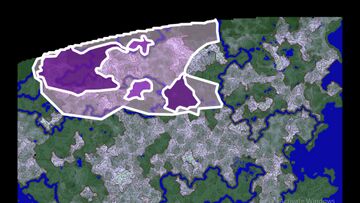 Borders of Prak's Ghaivati with the darker the color the more control over the land Prak had
-
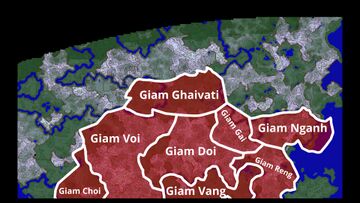 Borders of Northern Nam Moi
-
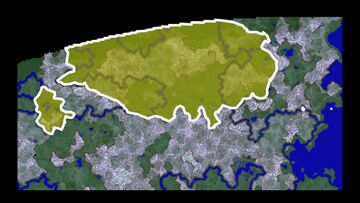 Borders of the Ghaivati during the Golden Age
-
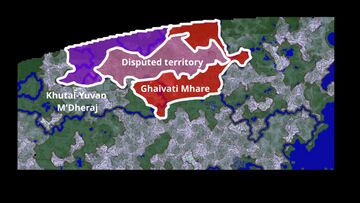 Borders of both Ghaivatis after the split
-
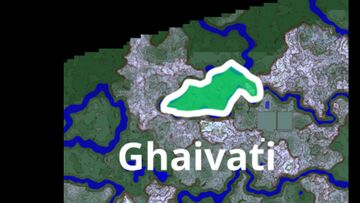 Current borders of the Ghaivati


Culture

Architecture
Classical Architecture
Classical Bhati architecture is marked by its intricate designs, symbolic representations, a focus on geometric harmony, and spires. It is mainly made from stone to withstand constant rain; unlike mud, it won't wash away. Not many representations of classical Bhati architecture remain, but there is a resurgence in Clebonia and Ghaivati.
Dheraj Architecture
Dheraj architecture is very boxy and colorful, coming from a trading partner from the east, Pram Poi, it is known as Nek Bek or limewash in their language. This style is also known as Khutaichuri, a Bhati word meaning limestone, since the houses look like huge blocks of limestone and also because the houses are always plastered with limewash to make them look white.
The Arts
Dance

The only uniform dance among the people is Senguttuvan, invented by the Ganesh family, it allowed for stories to be told without the actors and actresses speaking. Accompanied by singing and gamelan, the actors combine mudras like bending back their hands and making symbols with their hands, eye movement by rapidly firing their eyes left or right to match the beat of the music, and enlarging their eyes to emphasize something. Roles are easy to distinguish; people in power are going to wear a white chalky makeup with designs painted in red stone, along with covering most of their body to show their purity. The mischievous characters are very flexible, meaning they wear pants often associated with the color orange. The hero can be a mix of many things, but boiled down, painted nails and or face, with tied up hair and a skirt. The villain will usually have black or red painted skin and be very loud by stomping their feet. Of course, this is just Senguttuvan in a nutshell it will always depend on the theatre.
Music and Singing
Music and singing have always been around in the Bhati people. The first ever recorded gamelan show was in 321 when Prak Dheraj ordered music for her palace. While it was always associated with Senguttuvan, it wouldn't be fully incorporated until 3451 when Ghutema Bindra made the ruler pass the Uniformity Act of The Arts or UATA, which laid out all the rules and regulations for any Senguttuvan dance, a copy of which is within the Ghaivati archives, like most historical documents. Currently, only one theatre remains, which is in Ghaivati. Sharpahe, or literally wavy singing, is the classical way of singing for the Bhati people. It is called wavy singing due to its very usage of tons of vibrato and its jumpiness from note to note, from octave to octave. It was derived from the Mhar's clans' singing and turned into a uniform way of singing due to the UATA also being implemented into Senguttuvan.
Art

Forever, the Bhati people used art as a way of worshipping Bhat. A uniform art style emerged in 230 FoB, known for its elaborate and detailed patterns, often inspired by nature and incorporating symbolism. It was mainly flat color planes that lacked the use of light and shadow or perspective. often found in temples, depict scenes from Bhati scriptures, often continuous narratives, with elements arranged according to the story's timeline rather than strict spatial or proportional accuracy. Tons of vases were produced once the Bhati people found out about stamping designs onto porcelain. All of this stopped in 1010 when Moi Nam invaded, stopping this art style due to its impracticality and installed an artstyle where prespective and getting things acurate was more favored 90% of the artwork with in the archive is Moi Nam period art work after lethe destroyed tons of Bhati artwork for some reason leaving Moi Nam era art work untouched.
Food
Many recipes from ancient times are still able to be cooked because they were the first things ever written down on tablets. A huge diet of fish and poultry allowed the hunters to stay active. By the time of settlement, bread was a very common staple, along with beans. In 502, we get the Mora bhate M'phuri (MBP) or the Great Book of Food written by Jhana Voi. This book unlocked over 100 recipes of the Bhati People, showing off their diet slowly moved to soups rather than beans. Currently, the main served dish is still stew along with potatoes, with many meats.
Language

The Bhati language has 2 main dialects, Dheraj and Ganesh. They share about 85% of their vocabulary, 15% of the Dheraj dialect is loan words from the Rit keo language spoken by the Pram Poi people. 5% of both languages is made of Gio Di from the Moi Nam invasions, since that is what they spoke.
Phonology
| Bilabial | Labio-
dental |
Dental | Alveolar | Post-
Alveolar |
Retroflex | Platal | Velar | Uvular | Pharyngial | Glottal | ||
|---|---|---|---|---|---|---|---|---|---|---|---|---|
| Plosive | plain | b p | t d | k g | ||||||||
| aspirated | bʰ pʰ | tʰ dʰ | kʰ | |||||||||
| Nasal | m | n | ||||||||||
| Trill | ||||||||||||
| Tap | ɾ | ɽ | ||||||||||
| Fricative | plain | v | s | ʃ | h | |||||||
| Lateral Fricative | ɮ | |||||||||||
| Approximate | j | |||||||||||
| Lateral Approximate | l | |||||||||||
Aspiration
In most dialects, all aspiration is done except Dheraj and Western Ganesh. While Dheraj completely removes all aspiration when speaking, Western Ganesh turns the aspiration into palatalization.
| Front | Central | Back | |
|---|---|---|---|
| Unrounded | Rounded | ||
| Close | i | u | |
| Mid | e | o | |
| Open | a | ||
Spelling and Pronunciation
Almost every thing will be pronounced how it is spelled there are a few exceptions. When h is inebtween 2 vowels it wont asperate the first vowel it will become a Unvoiced Gloattl Friciative. M, v, and g will not asperate at all it was spelling decision made in 1015 by Moi Nam in the Vang Nha Thuy Mo (VNTM). The VNTM or Document of Spellings and Corrections DSC was a bill based by Moi Nam forcing all people to switch to a latin based text instead of the logosyllabic writting system of the Bhati people only exception to this rule was the people of the clergy, so monks and preiest, because they threatened to put the Moi Nam's Emperor's head on a spike. Most to every word was fine except electrum and gold both are prenounced /maɾpʰene/ meaning yellow stone so when Moi Nam tried ordering 14 chetchis of gold from the Ghaivati province, in a note written in latin based text, they got electrum instead. The only distiction between them was the determinative at the end of the word in the Bhati script so the VNTM made gold maraphene and electrum mharaphene and forced every one to learn the latin script.
Death and Rebirth
Rituals
Once a body of a deceased animals or human has been submitted to a temple it will be placed into a bed of salt for 50 days. Once the body is fully dried it will be stuffed with spices and incense by priest also being covered in Khala made from sap, cinnamon, water, and lime making the corpse covered in limewash giving it look like a white blob. Once all these steps have been done it can be rapped on a huge sheet of wool or linen. Then it can placed into a wood, silver, gold, or cooper anthropoid coffin designed with the owners looks and carved with spell of the holy books. While this whole process is happening a 1:1 scale clay statue of the deceased will be formed, sculpted, and painted blue to represent holiness and its called a Kalmani only showing the owner with perfect features and with tons of wealth. Richer people will have theirs not formed of clay but of gold plated wood. With the construction done of the Kalmani it will be paraded around town to their favorite spots in life on top of a palanquin held up by their loved ones. Until arriving at the local temple where an offering ceremony would occur loved ones, friends, acquaintances, and even strangers will show up to shower the statue with orange flower petals and leave loafs of bread for the statue.

Burial
On an even numbered day at an even numbered hour the coffin holding the body will be dragged into the tomb being lowered into the floor while all the loved ones in the town mourn out loud. Preist chant spell 3 of the Book of Rai carrying in all the grave goods once all grave goods have been put inside the tomb every one but the highest preist present must leave and return home as the priest incenses the tomb before speaking spells 1,12,13, and 14 out loud before incensing the tomb once more and then putting the Kalmani into a pool of water inside the tomb for it to break back down into clay representing reincarnation. The priest would climb out of the tomb giving the order to seal it off meaning tons of sand or dirt would fill the hole accessing the tomb before a small building would be placed ontop with a painting of the deceased and an offering plate so family can leave offerings to the dead.